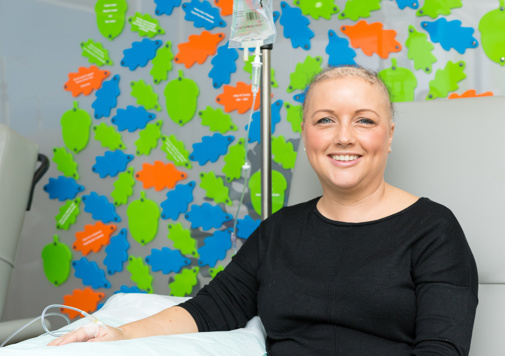
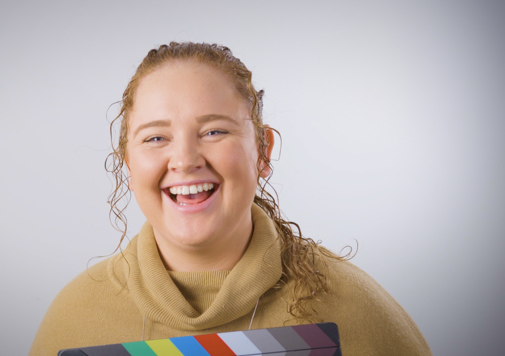
Meet Kate .

Diagnosed with melanoma at 32, Kate faced a challenge she never saw coming: what her treatment could mean for her chances of becoming a mum.

“One thing you don’t think about when faced with a cancer diagnosis is your own fertility, and this hadn’t really crossed my mind until going through the treatment plan.”

“I didn’t realise that an itchy red area on my back, that I thought had been caused from carrying my rucksack while travelling, would make me face the emotional discovery about my fertility.”

When Kate Howson, 32, and her partner, Rhys were invited to be part of two overseas weddings – one in New Zealand February 2024 and the other at the end of February in Thailand.  The couple from Cardiff decided that it was the perfect excuse to take a sabbatical from their jobs and go travelling either side of these weddings.

It was while they were away that Kate became aware of an itch in the middle of her back where a mole was. When she got Rhys to check, he said the area around it looked quite red.

“It was exactly where my rucksack was sitting and as we’d been traveling for a month or so I assumed it was where it had been rubbing against my skin. We took a photo and sent it to my sister-in-law, who’s a doctor to see what she thought. She said it was best I got it checked as soon we came home.”

Not long after they returned in March, Kate looked in the mirror and could see that the area had become darker in colour and that it had changed in shape, it looked more irregular. She took another photograph to compare with the original one taken few months earlier, so that she could share these with her GP.

She was sent to the dermatology department at The Heath hospital in Cardiff, where they advised in that moment, there was a high chance it was cancerous.

They removed the mole the same day and later confirmed it was a melanoma.

Kate was referred to have a procedure called a sentinel lymph node biopsy, which involves dye being put into the site of the original mole so that it can be tracked by where the dye goes, showing the most likely route of where the cancer has spread to.

“They scanned me to see the most likely route the cancer might have taken if it had spread, and in my case, it had gone to my groin. I then had an operation to remove those lymph nodes and when the results came back from the biopsy, it showed that it had gone from a stage 2 to a stage 3, it had metastasised.”

It was just before Christmas that Kate found out the results.
Kate was referred to Velindre to discuss treatment options. Her oncologist had initially offered immunotherapy, but as Kate had the BRAF mutation (this causes the melanoma cells to make a protein that encourages the cells to grow) they decided that cancer-targeting drugs were the best form of treatment for her.  Unfortunately, taking these tablets can come with side-affects.

“The potential or unknown impact on my fertility with these drugs. was one of the side-affects I was most concerned with as Rhys and I had talked about starting a family, so we discussed this with my oncologist before starting treatment and we were offered one round of IVF before starting treatment.”

“It was at this point we found out that my egg reserves were abnormally low - they only managed to harvest three eggs.”

As time was of the essence, Kate and Rhys decided to pay for a second round of IVF fertility clinic before she started treatment for her melanoma, and this time opted for embryo freezing, they only harvested a few eggs again and sadly these didn’t fertilise.

“One thing you don’t think about when faced with a cancer diagnosis is your own fertility, and this hadn’t really crossed my mind until going through the treatment plan.”

Rhys and I had talked about both wanting to have children before this diagnosis and coming from big families, we took it for granted that one day we would.

“Suddenly finding out I had low fertility at this point felt like another huge blow.”

After trying with IVF, they felt they had to park this part of their lives for the next year as Kate began her treatment in April.

During this time, Kate was offered counselling through our support services.

“I have never had any therapy myself up to this point, so was a little apprehensive as to whether it may work for me. But I wear my heart on my sleeve in life, so it didn’t take long for me to open up and share feelings with Sam who put me at ease right away. If it had just the cancer diagnosis, I thought I would be ok and that we could get through this.”

Kate explains that the thing that tipped her over the edge was finding out about her fertility.

“The hard and unexpected journey we had to take in getting these rounds of IVF before me starting treatment, and for them not to have worked, is heartbreaking.”

Talking to Sam, who’s one of the counsellors with Tenovus Cancer Care, has helped me get these thoughts out of my head and open up the conversations I need to have right now.

Working as a research partnership manager in the research team at Social Care Wales, Kate’s role helps to link practitioners with academics and develop the storytelling framework.

“It’s through my own work that I can see the impact of other people’s stories and the power that they have. This is one of the reasons I was keen to share my own story.”

Kate and Rhys continue to travel and plan trips away in their campervan whenever they can. Which feels like an oasis of adventures they can dip into, during a time that has felt so out of control for them.

“For me, I could never have imagined going through this at age 32, and the subsequent challenges we’ve faced in relation to fertility. Of course, this has made me more vigilant about my own sun-safety. It means I am more in tune with the moles on my body and I would say don’t be afraid to get them regularly checked, especially if you think they’ve changed and take pictures so that you can track any changes.”

“Being outdoors and exploring new places is something that I love doing, but I just have to be a little bit more careful when doing so now.”

Kate spotted a change and acted. Would you know the signs and symptoms of skin cancer?

If you or someone you love has been affected by cancer, our free Support Line is there for you. Just call 0808 808 1010